The Golden Echoes of Dussehra: A Tapestry of Light, Legend, and Letters

There is a distinct, lingering magic in the air as autumn settles over the subcontinent. The early morning sky carries a soft, pearl-grey haze, and the breeze smells faintly of wet earth, crushed marigolds, and burning camphor. Across towns, villages, and bustling metros, an unwritten rhythm takes over. This is the threshold of Dussehra—or Vijayadashami—a festival that does not merely arrive on a calendar page, but awakens a deep, ancestral memory within the Indian consciousness.
At its heart, Dussehra is a song of victory. It is the timeless chronicle of light casting away dark shadows, of moral grace triumphing over arrogance, and of humanity renewing its pledge to truth and wisdom. Yet, as we step across its cultural expanse, we realize that Dussehra is not just one story; it is a thousand sacred whispers woven into a single, breathtaking tapestry.
The Roar of Battle and the Triumph of Grace
Step into the realm of ancient mythology, and Dussehra reveals its fierce, heroic origins. In the epic traditions of the North, this day marks the climax of the Ramayana. After ten grueling days of cosmic warfare, Lord Rama pierces the armor of the ten-headed demon king Ravana, rescuing Sita and restoring moral order (Dharma) to the earth. As twilight falls on Vijayadashami, towering effigies stuffed with crackers go up in brilliant bursts of orange and gold across public grounds—a visceral, dramatic spectacle reminding every watcher that even the most formidable ego eventually crumbles to ash.
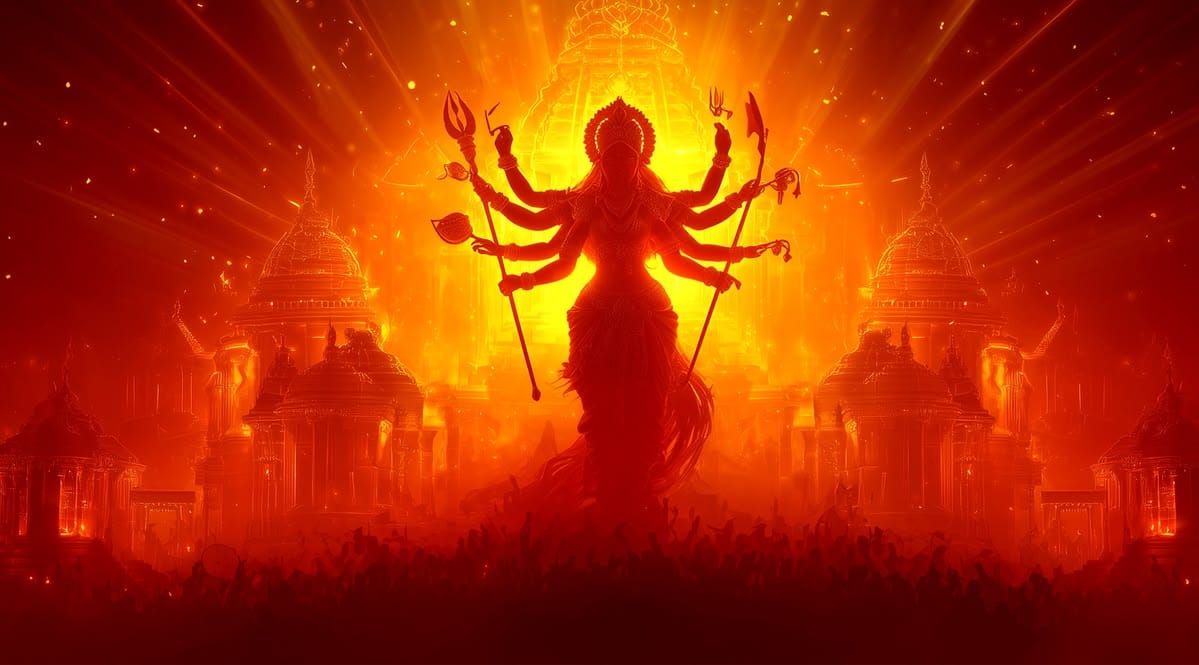
Travel toward the East and South, and the legend shifts to the divine feminine. For nine nights, the universe held its breath as Goddess Durga fought the deceptive, shape-shifting demon Mahishasura. On the tenth morning, armed with the collective radiance of all the gods, the Mother Goddess struck down the terror of the worlds. In every temple chime and drumbeat of Vijayadashami, one hears the victorious echo of that sacred conquest.
From Royal Palaces to Sacred Silence: Regional Splendors
What makes Dussehra truly magnificent is how seamlessly it adapts to the soul of every region.
In the historic heart of Karnataka, the festival retains its royal majesty through Mysuru Dasara. For ten days, the Mysuru Palace blazes with over a hundred thousand incandescent bulbs, transforming into a golden jewel against the dark night. The streets overflow with music, folk dancers, and vibrant tableaux, culminating in the world-renowned Jamboo Savari—a grand procession where a decorated royal elephant carries the golden idol of Goddess Chamundeshwari in a 750-kilogram palanquin.
In stark contrast to this grand spectacle is the quiet, deeply introspective tradition of Kerala. Here, the essence of Vijayadashami is found not in giant effigies, but in the silence of Pooja Vaypu. On the eve of Durgashtami, books, musical instruments, and tools of creation are laid at the feet of Goddess Saraswati. For three days, a sacred stillness descends upon households. Children gaze longingly at their tied-up storybooks, learning a quiet lesson in reverence—that knowledge is not a commodity to be rushed, but a divine blessing to be awaited.
The First Stroke of the Golden Ring: Vidyarambham
On the dawn of Vijayadashami, that sacred silence breaks into a gentle, golden celebration known as Vidyarambham—the initiation into learning.
Long before sunrise, courtyards are washed clean and temples resonate with soft chants. Little children, bathed in cool water and dressed in traditional attire, are led by their parents into temple precincts and cultural halls. There is a sweet, chaotic harmony to the scene: tiny hands wiping away sleep, the comforting warmth of Trimadhuram (the sacred offering of plantain, honey, and jaggery) melting on little tongues, and the nervous whimpers of toddlers intimidated by the crowd.
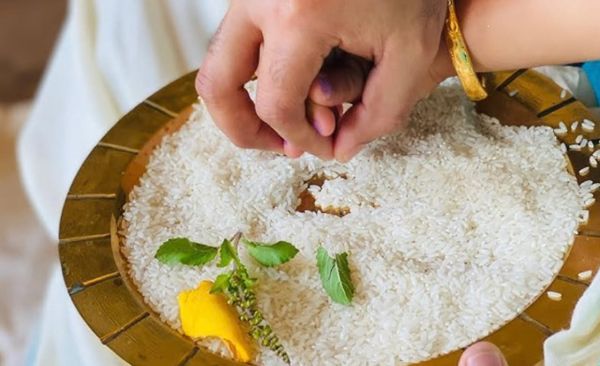
Then comes the magic moment. Seated on the lap of an elder, a guru, or a beloved grandparent, the child’s small index finger is gently guided. A golden ring or a stylus traces those immortal syllables—Hari Shree Ganapataye Namah—first into a brass platter filled with raw rice grains, and then upon the child's tender tongue.
As the white grains scatter to form the shapes of vowels and consonants, a new journey begins. It is an emotional, deeply moving ritual—a bridge connecting a fresh young soul to thousands of years of language, art, and intellectual heritage.
An Eternal Light in a Fast-Changing World
We live in an age dominated by sleek glass screens, instant notifications, and digital avatars. Today, toddlers often swipe through tablets before they can walk, and cultural rituals are frequently live-streamed across oceans.
Yet, when Dussehra arrives, it gently strips away our modern cynicism. It reminds us that no matter how advanced our tools become, the human heart still hungers for meaning, connection, and sacred beginnings. Burning an effigy is ultimately about confronting the inner monsters of greed and pride; tracing letters in raw rice is about approaching learning with humility and wonder.
As the dusk settles on another Vijayadashami, leaving behind the warmth of oil lamps and the sweet aftertaste of temple prasadam, Dussehra whispers an enduring promise to us all: that light will always conquer darkness, and every new beginning holds the seeds of an infinite future.